
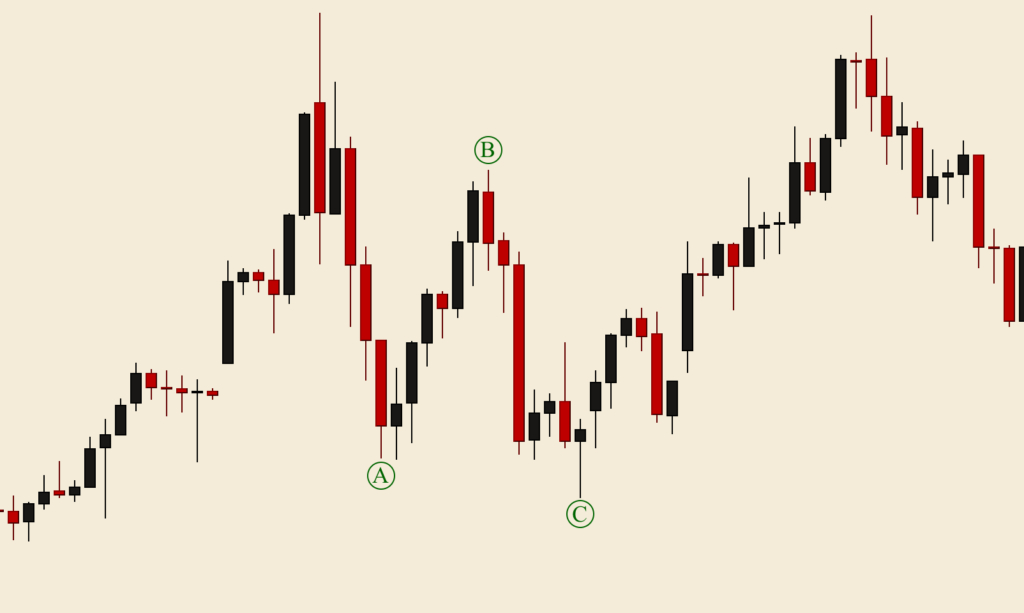
Rules
A zigzag is a corrective pattern composed of three waves, labeled A, B, and C.
Wave A must unfold as either an impulse or a leading diagonal. Wave C is a motive wave and must develop as either an impulse or an ending diagonal.
Wave B acts as the corrective phase of the pattern and may take the form of any corrective structure, including zigzags, flats, triangles, or complex combinations. Wave B must never retrace beyond the starting point of wave A.
Guidelines
In the vast majority of cases, wave C extends beyond the termination of wave A. Although truncation—where wave C fails to exceed wave A—is theoretically possible, it is considered extremely rare in practice.
Zigzags may sometimes expand into more complex corrective sequences known as double or triple zigzags, labeled W–X–Y and W–X–Y–Z respectively. In such formations, waves W, Y, and Z each subdivide into their own ABC zigzag, while the connecting X waves serve as linking corrections and may take the form of any corrective pattern. Extended zigzags typically occur when a single zigzag is insufficient in both price movement and time to properly correct the preceding trend.
Zigzag formations can vary in appearance, but several characteristics help distinguish them from impulsive price movements. A common feature is a relatively high degree of overlap between waves A and B. In addition, wave A in a zigzag often completes more quickly—both in time and magnitude—than wave 1 of an impulse. Structurally, zigzags usually form relatively shallow, gently sloping channels, whereas impulsive 1–2–3 advances tend to be noticeably steeper.
Fibonacci Retracement and Extension Guidelines
In many zigzag corrections, waves A and C frequently display proportional equality, with wave C often reaching approximately 100% of wave A. Other commonly observed relationships include wave C extending to roughly 161.8% or contracting to around 61.8% of wave A.
Wave B typically retraces a portion of wave A, most often within the 38.2% to 88.6% range.
If wave B develops as a triangle, there is an increased probability that wave C will terminate near the 61.8% extension level.
When wave B forms a running triangle, the retracement is usually shallow, most commonly limited to approximately 10% to 40% of wave A.
If wave B unfolds as a sideways corrective structure, retracements are most often seen in the 38% to 50% range of wave A. When wave B itself forms a zigzag, deeper retracements are more common, typically between 50% and 79% of wave A.