
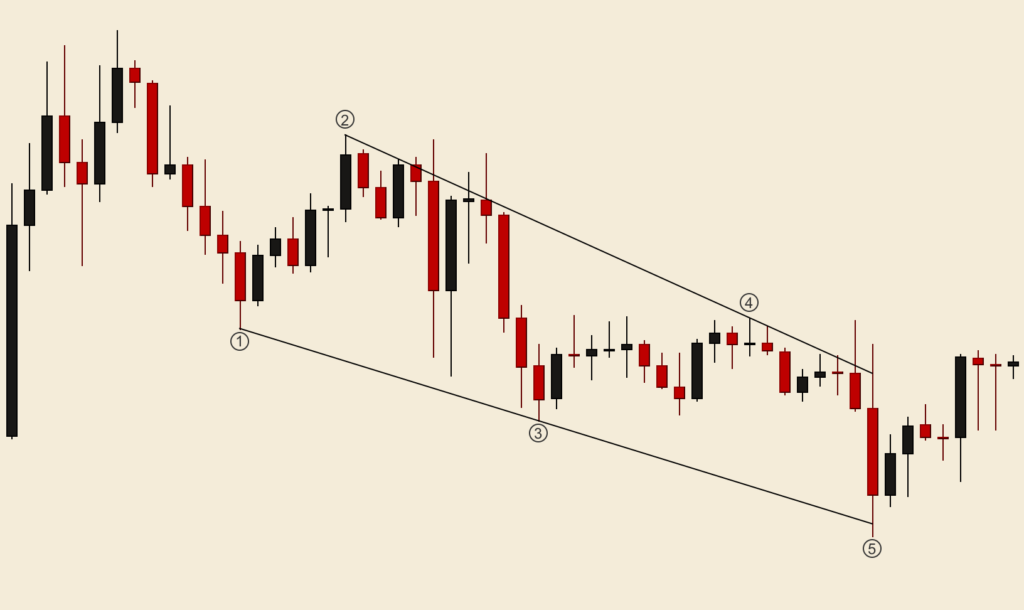
Rules
All diagonals consist of five waves. Diagonals can be either leading or ending, depending on whether they form at the beginning or at the end of a trend. As a result, diagonals can only appear in the position of wave 1 (leading) or wave 5 (ending) of an impulse, or in the position of wave A (leading) or wave C (ending) of a zigzag.
Within an ending diagonal, all five waves must be zigzags. Simple, double, and triple zigzags are all valid. Within a leading diagonal, at least waves 2 and 4 must be zigzags, while waves 1, 3, and 5 may be either impulses or zigzags. If waves 1, 3, and 5 are impulses, caution is required, as the structure may instead be a 1-2, 1-2, 1-2 sequence rather than a true diagonal.
Wave 2 must not retrace more than 100% of wave 1. Wave 4 is not required to overlap with wave 1 under the updated rules. However, it is still considered very uncommon for wave 4 not to enter the price territory of wave 1. Wave 4 must never move beyond the end of wave 2.
Leading and expanding diagonals must not have a truncated fifth wave. Under earlier Elliott Wave rules for contracting diagonals, wave 3 was required to be shorter than wave 1 in terms of percentage gain or loss. Under the updated rules, wave 3 is allowed to be longer than wave 1. The only strict requirement for contracting diagonals regarding waves 1, 3, and 5 is that wave 5 must be shorter than wave 3.
In expanding diagonals, earlier Elliott Wave rules required wave 3 to be longer than wave 1, wave 5 to be longer than wave 3, and wave 4 to be longer than wave 2 in terms of percentage gain or loss. Under the updated rules, the only strict requirement regarding waves 1, 3, and 5 in an expanding diagonal is that wave 5 must be longer than wave 3.
Guidelines
Contracting diagonals form within two converging trend lines, creating a contracting wedge. During wave 5, these diagonals may overshoot their trend line, known as a throw-over, and still remain valid as long as wave 5 is smaller than wave 3. Contracting ending diagonals may also undershoot the trend line during wave 5, resulting in truncation.
Contracting ending diagonals should almost always display a clear decrease in momentum as they progress toward completion. A series of small candles taking a long time to achieve additional price movement is a strong indication that an ending diagonal is forming. Conversely, strong and large candles within a potential diagonal structure should serve as a warning sign, as they often indicate a 1-2, 1-2, 1-2 extension of the trend rather than an ending diagonal.
Expanding diagonals form within two diverging trend lines, creating an expanding wedge. These patterns are considerably rarer than contracting diagonals.
Waves 2 and 4 of any diagonal very often retrace waves 1 and 3 much deeper compared to waves 2 and 4 of impulse structures. The internal zigzags within diagonals may sometimes subdivide into more complex double or triple zigzag formations.
A diagonal structure can begin to be confirmed with higher confidence once wave 4 is nearing completion. Diagonals are relatively rare overall, although they do occur more frequently within sub-waves of very small degrees, particularly on lower timeframes such as M15 and below.
If wave 1 is a leading diagonal, wave 3 is usually extended. A common area to watch for potential expanding leading diagonals is at the start of stock market declines, due to opposing forces acting during transitional phases.
Ending diagonals are most often followed by a strong and sharp reversal.