
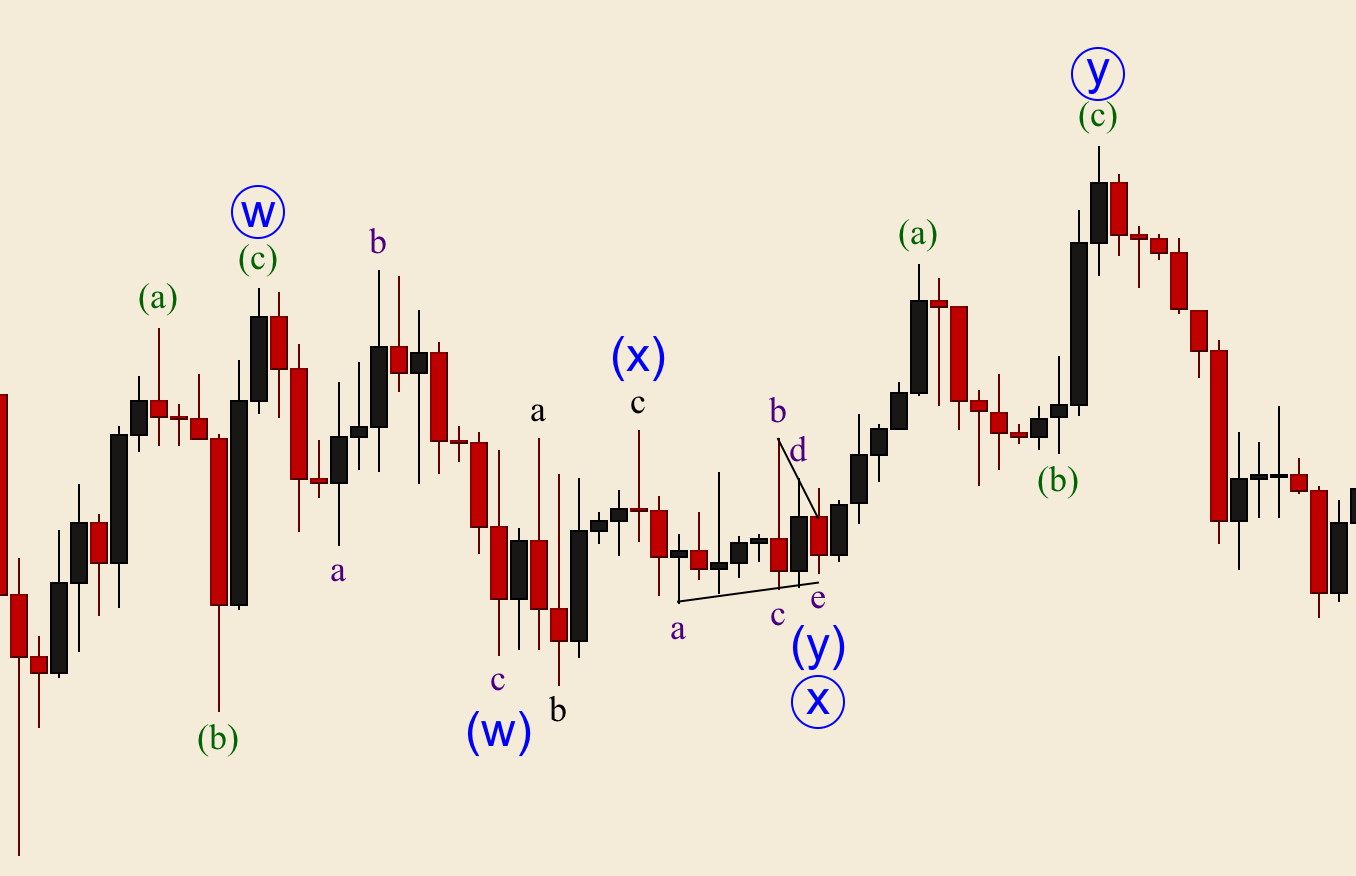
Complex sideways combinations are corrective structures that create prolonged, overlapping, and range-bound price action.
Note: Complex zigzag combinations are covered in the Zigzag section. This section deals exclusively with complex sideways combinations.
Rules
A complex sideways combination consists of either three or five corrective patterns that alternate in orientation, resulting in a sideways movement. The intervening corrective waves, known as X waves, always orient in the direction of the previously established trend.
A Double Three consists of three corrective patterns labeled W–X–Y, while a Triple Three consists of five corrective patterns labeled W–X–Y–X–Z. In both cases, the corrective patterns alternate in direction.
A Double Three may consist of the following combinations:
• zigzag (W), any corrective pattern (X), and flat (Y)
• zigzag (W), any corrective pattern (X), and triangle (Y)
• flat (W), any corrective pattern (X), and triangle (Y)
• flat (W), any corrective pattern (X), and flat (Y)
• flat (W), any corrective pattern (X), and zigzag (Y)
Within a Double Three, only one zigzag and one triangle are allowed across the W and Y positions. Wave X may be any corrective pattern and may itself subdivide into complex combinations, including smaller-degree double or triple threes.
A Triple Three follows the same structural logic as a Double Three. Only one zigzag and one triangle are allowed across the W, Y, and Z positions. As with Double Threes, X waves may be any corrective pattern and may themselves subdivide into complex combinations of a smaller degree.
Triangles are only permitted to form in the final wave of the combination sequence. This means wave Y in a Double Three and wave Z in a Triple Three.
Important Methodological Note
Opinions differ among Elliott Wave researchers regarding whether waves W, Y, and Z are allowed to be complex combinations themselves. Original Elliott Wave research states that waves W, Y, and Z must each subdivide into a simple corrective pattern—zigzag, flat, or triangle—at the next lower degree, while only X waves are allowed to contain smaller complex combinations.
Some modern analysts argue that contemporary market behavior is more complex and therefore permit additional complexity within W, Y, and Z. However, further complicating these waves often leads to over-labeling and increases the risk of misjudging trend continuation or correction targets.
It is recommended to adhere to the original guidelines: W, Y, and Z should subdivide into simple corrective patterns, with complexity reserved for X waves.
Guidelines
Triple Threes are significantly rarer than Double Threes.
Although X waves could theoretically form as triangles in addition to a triangle forming in the final wave of the combination, such a structure has never been observed in practice and is extremely unlikely given underlying market dynamics. As a result, if an X wave forms as a triangle, the final Y or Z wave will almost certainly not be another triangle.
Expanding triangles are exceptionally rare within complex combinations and, as far as is publicly known, may never have occurred.
Fibonacci Retracement and Extension Guidelines
Sideways combinations are inherently range-bound structures. In most cases, the internal waves retrace each other by approximately 78% to 138%, resulting in either a near-horizontal movement or a channel that slopes only very gently against the direction of the preceding trend.
Within this general range, wave X most commonly retraces the preceding corrective wave by approximately 78% to 138%. Wave Y is frequently related to wave W by a Fibonacci proportion of roughly 61.8% to 123.6%, reinforcing the overlapping and sideways nature of the formation.
Alternatively, the target for wave Y can also be projected by measuring the distance from wave W to wave X and applying Fibonacci proportions to that move. When using this method, wave Y most commonly reaches approximately 78% to 138% of the W–X measurement. This approach helps define a broader and more flexible target zone, particularly in choppy or overlapping market conditions.