
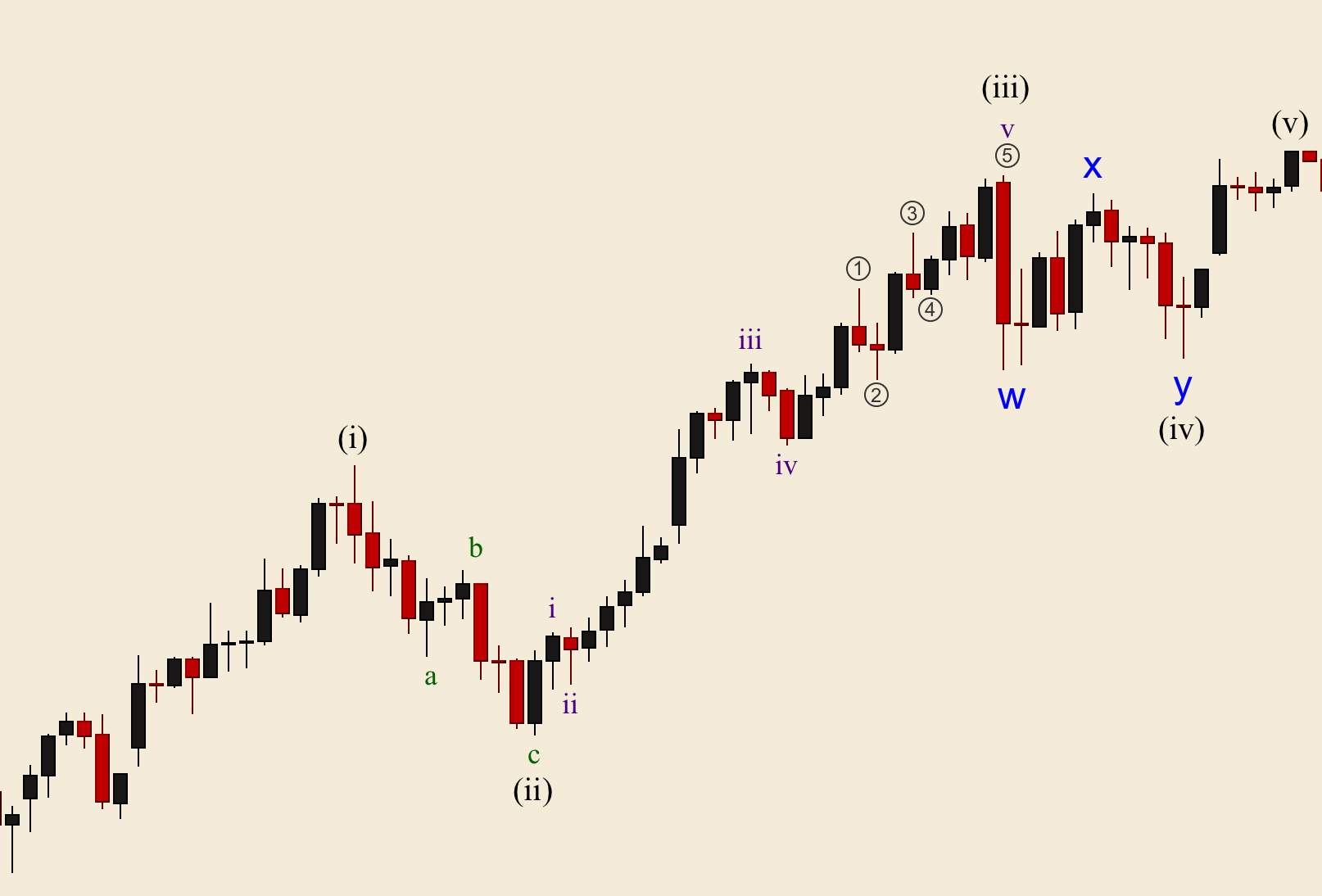
Image: Alternation between sharp single zigzag in wave 2 and complex sideways structure in wave 4
Elliott Wave patterns tend to exhibit alternation. Alternation helps create proportional and visually coherent wave structures. Below are the most common and important forms of alternation observed in Elliott Wave analysis.
Alternation of Corrective Waves
If wave 2 is sharp in form—such as a zigzag or extended zigzag—and deep in terms of retracement of wave 1, then wave 4 will most often develop as a sideways corrective structure, such as a flat, combination, or triangle, and will typically be shallow relative to wave 3. The reverse scenario can also occur, but it is less common.
This behavior is partly explained by the unique nature of triangles. Since triangles can only appear in wave 4 within a motive wave, they are considered structurally alternating to all other corrective patterns. As a result, even if wave 2 develops as a shallow sideways correction, a triangle may still form in wave 4, although the probability is lower.
Alternation also applies to complexity. If a larger corrective structure begins in a simple form, complexity is likely to increase as the correction progresses, often following a simple → complex → most complex sequence. The reverse progression—most complex → complex → simple—can also occur, but it is significantly less common.
Alternation of Motive Waves
Alternation is also evident among motive waves. If wave 1 is relatively short, wave 3 is likely to be extended, with wave 5 once again remaining short. If wave 1 is extended, then waves 3 and 5 are usually not extended. If neither wave 1 nor wave 3 is extended, wave 5 will often become extended.
If wave 3 becomes exceptionally long and overstretched, wave 5 is at increased risk of truncation.
Balanced Proportions (“The Right Look”)
For a wave count to be valid, waves within a five-wave or three-wave sequence must display reasonably balanced proportions. This balance applies not only to price magnitude—often evaluated using Fibonacci retracement and extension relationships—but also to time duration. Balance can be achieved through alternation, equality, or a combination of both.
An example of balance through alternation occurs when an impulse displays a deep but short-lived wave 2, followed by a shallow yet time-consuming wave 4. In this case, the duration of wave 4 balances the depth of wave 2, while the shallowness of wave 4 balances the brevity of wave 2, resulting in overall proportional harmony.
The same requirement for balance applies to motive waves within a five-wave sequence, namely waves 1, 3, and 5. The primary exception is the extended wave. An extended wave may be substantially larger in both magnitude and time compared to the other waves. However, the internal sub-waves within the extended wave must still display balance relative to one another.
Extended waves also maintain proportionality with the broader sequence through the angle of price movement. This is why impulsive waves often travel cleanly within parallel channel lines, even when one wave is extended.
An example of balance through both equality and alternation occurs when waves 1 and 5 are equal in size and duration, while wave 3 is extended, alternating structurally with waves 1 and 5.
Practical Warnings
Caution is warranted when a potential wave 4 begins to grow disproportionately large in either price or time relative to the other waves of the same degree. Such behavior often signals an incorrect wave count.
Disregarding balanced proportions is dangerous in Elliott Wave analysis. Disproportionate or misshapen patterns should always be questioned.
Finally, the “right look” may not be visible across all degrees of trend simultaneously. It is therefore best to focus analysis on the wave degrees that are clearest and most structurally coherent.