
Rules
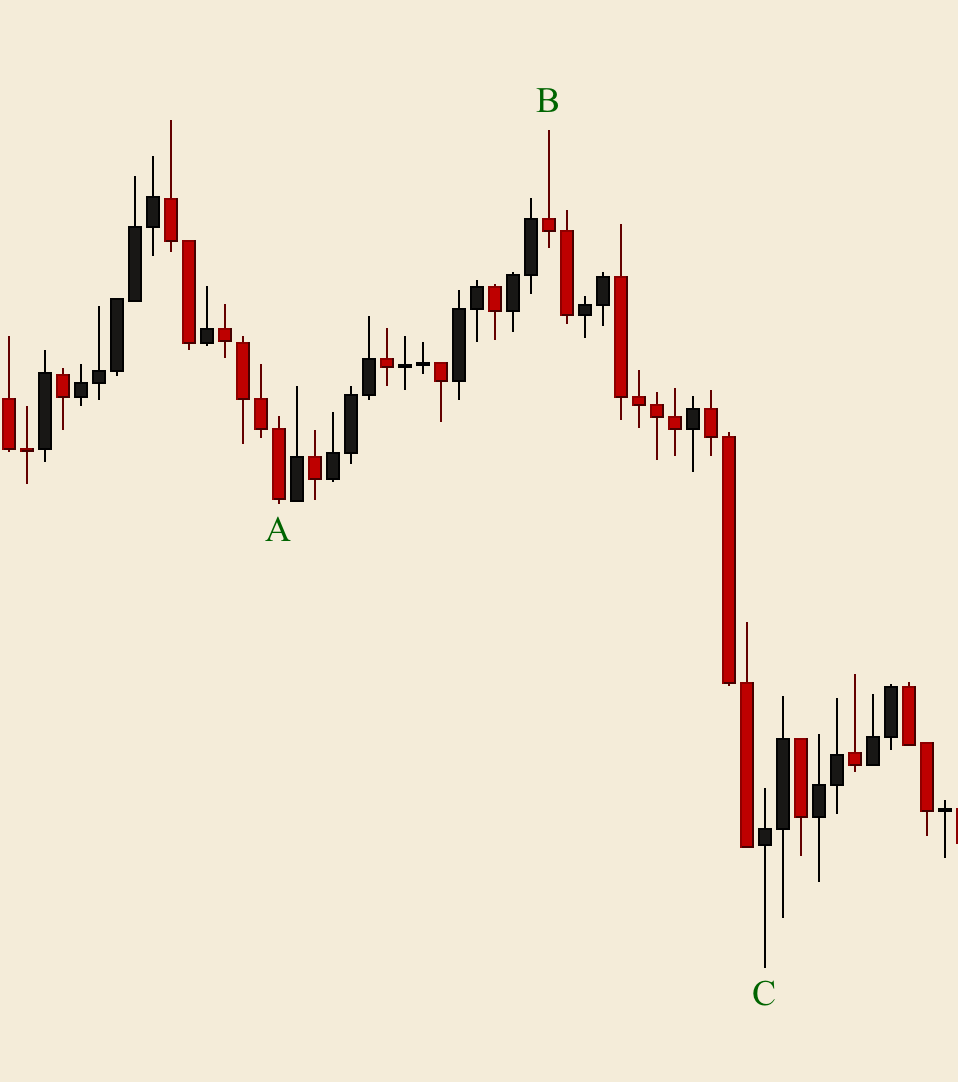
All flat corrections consist of three waves, labeled A, B, and C.
Waves A and B must subdivide into corrective patterns, although wave A cannot be a triangle. Wave C must be a motive wave and therefore must take the form of either an impulse or a diagonal.
Wave B must retrace at least 90 percent of wave A.
Guidelines
Under the classical Elliott Wave rules, a structure is classified as a Regular Flat when wave B retraces approximately 90% to 105% of wave A. In this framework, wave B does not exceed the origin of wave A, and wave C typically terminates near equality with wave A, often slightly beyond it.
A structure is classified as an Expanded Flat under the classical rules when wave B retraces beyond the origin of wave A, most commonly reaching 123% to 138% of wave A. In expanded flats, wave C normally moves beyond the end of wave A and often extends further than in regular flats.
Under updated and more practical Elliott Wave guidelines, acknowledged and approved by Prechter, the distinction between regular and expanded flats can be simplified. In this modern interpretation, a Regular Flat is defined when wave B retraces approximately 90% to 99% of wave A, meaning wave B remains below the origin of wave A. An Expanded Flat is defined whenever wave B exceeds the origin of wave A, regardless of the exact percentage retracement.
In regular flats, wave C is expected to move beyond the end of wave A.
In expanded flats, two outcomes are possible. In the most common case, wave C moves beyond the end of wave A, forming a standard expanded flat. In rarer cases, wave C fails to exceed the end of wave A despite wave B having exceeded the origin of wave A. This variation is known as a running flat and is therefore a subtype of the expanded flat.
Because running flats are uncommon, alternative wave counts should always be carefully evaluated before assigning this label, particularly on higher timeframes.
Whenever a strong impulse appears to terminate with a three-wave move and then reverses sharply, caution is warranted, as the structure may be an expanded flat and the prior trend may resume abruptly.
Fibonacci Retracement and Extension Guidelines
Wave C most commonly measures between 100% and 161.8% of wave A. In expanded flats, deeper extensions such as 161.8% are more typical. On rare occasions, wave C may extend as far as 261.8% of wave A.
In some cases, wave C targets can also be projected using the start of wave A as the base for Fibonacci extensions rather than the start of wave C. This alternative measurement produces slightly different price levels and helps define a broader target zone.