
Rules
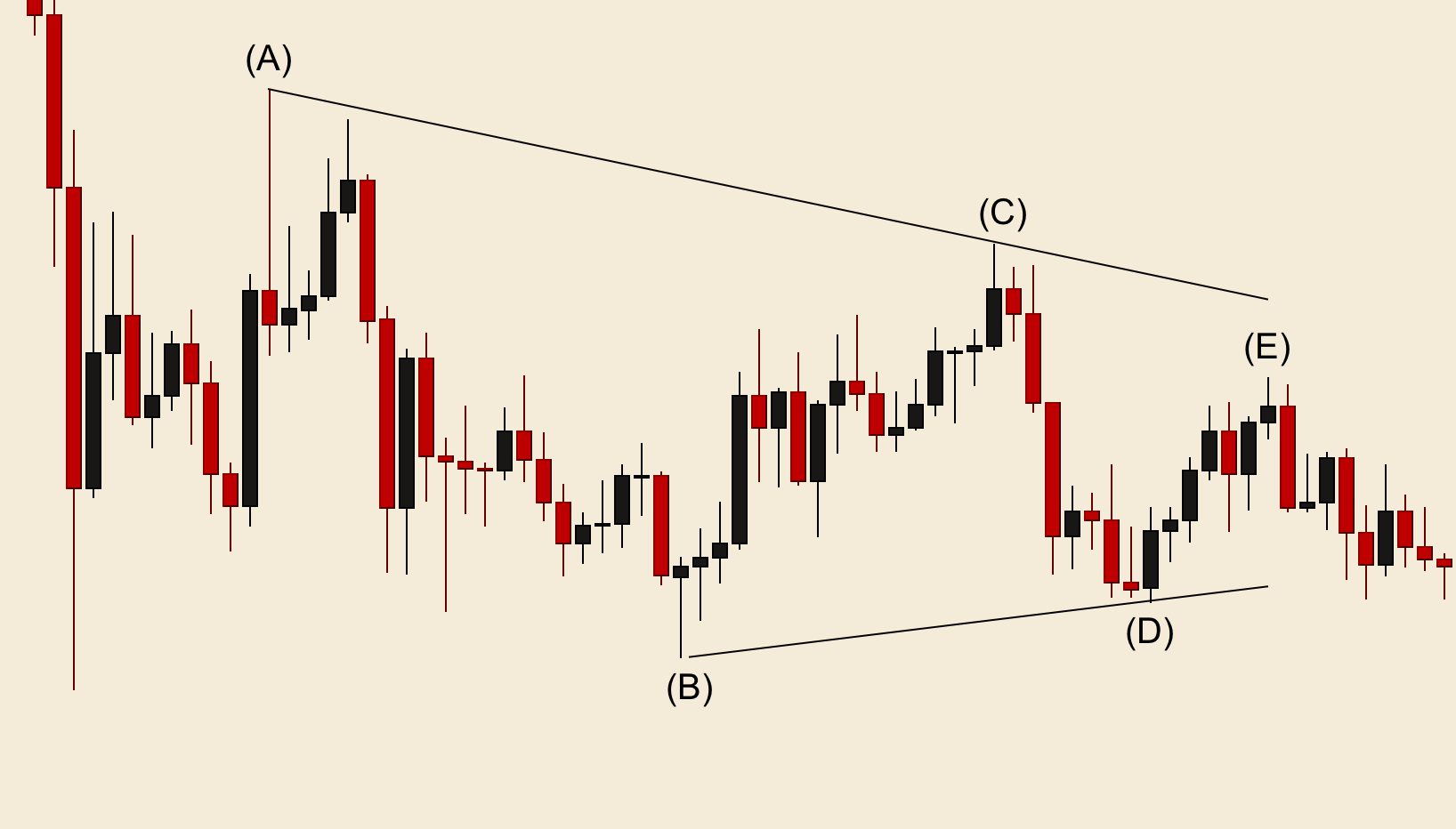
All triangles consist of five corrective waves, labeled A, B, C, D, and E.
A triangle can only appear in specific positions within a wave structure: as wave 4 of an impulse, wave B or X of zigzags and flats, wave Y of double three sideways corrections, or wave Z of triple three sideways corrections.
At least four of the five waves within a triangle must subdivide into zigzags. A triangle may contain no more than one complex wave. If a complex wave is present, it can only take the form of a double or triple zigzag.
In contracting and barrier triangles, wave C must not move beyond wave A, wave D must not move beyond wave B, and wave E must not move beyond wave C. This produces two converging trend lines as the triangle develops. The defining feature of a barrier triangle is that it forms a nearly horizontal trend line between points B and D.
In an expanding triangle, waves B, C, D, and E must each retrace at least 100 percent, but no more than 150 percent, of the preceding wave. This results in two diverging trend lines as the triangle progresses.
Guidelines
In a contracting triangle, wave B can end beyond the start of wave A in approximately 60 percent of cases. When this occurs, the structure is referred to as a running contracting triangle.
Wave E will very often undershoot or overshoot the triangle’s trend line. This behavior is normal and does not invalidate the structure.
Expanding triangles and barrier triangles are significantly rarer than contracting triangles. Within triangles, it is common for one of the waves to become complex, most frequently wave C or wave D, which may subdivide into a double or triple zigzag. In some cases, wave C, D, or E may itself subdivide into a barrier or contracting triangle.
If the final wave E subdivides into a triangle, the entire structure may visually appear to extend into nine waves, becoming increasingly narrow as it progresses. In such cases, the structure is labeled A-B-C-D-E-F-G-H-I.
During contracting and barrier triangles, both momentum and volume typically decline as the pattern develops.
Once wave E is complete, a post-triangle thrust—most often wave 5—usually follows. This thrust commonly travels a distance roughly equal to the width of the triangle measured at its widest point near the start of the formation. In commodity markets, the post-triangle thrust is often the longest wave of the entire trend.
Fibonacci Retracement and Extension Guidelines
In contracting and barrier triangles, many internal waves commonly exhibit Fibonacci relationships of 61.8% to 78.6% relative to the preceding or alternating wave.
In running contracting triangles, wave B should not retrace more than 161.8% of wave A.
In expanding triangles, wave C is commonly 161.8% of wave A, wave D is commonly 161.8% of wave B, and wave E is commonly 161.8% of wave C.