
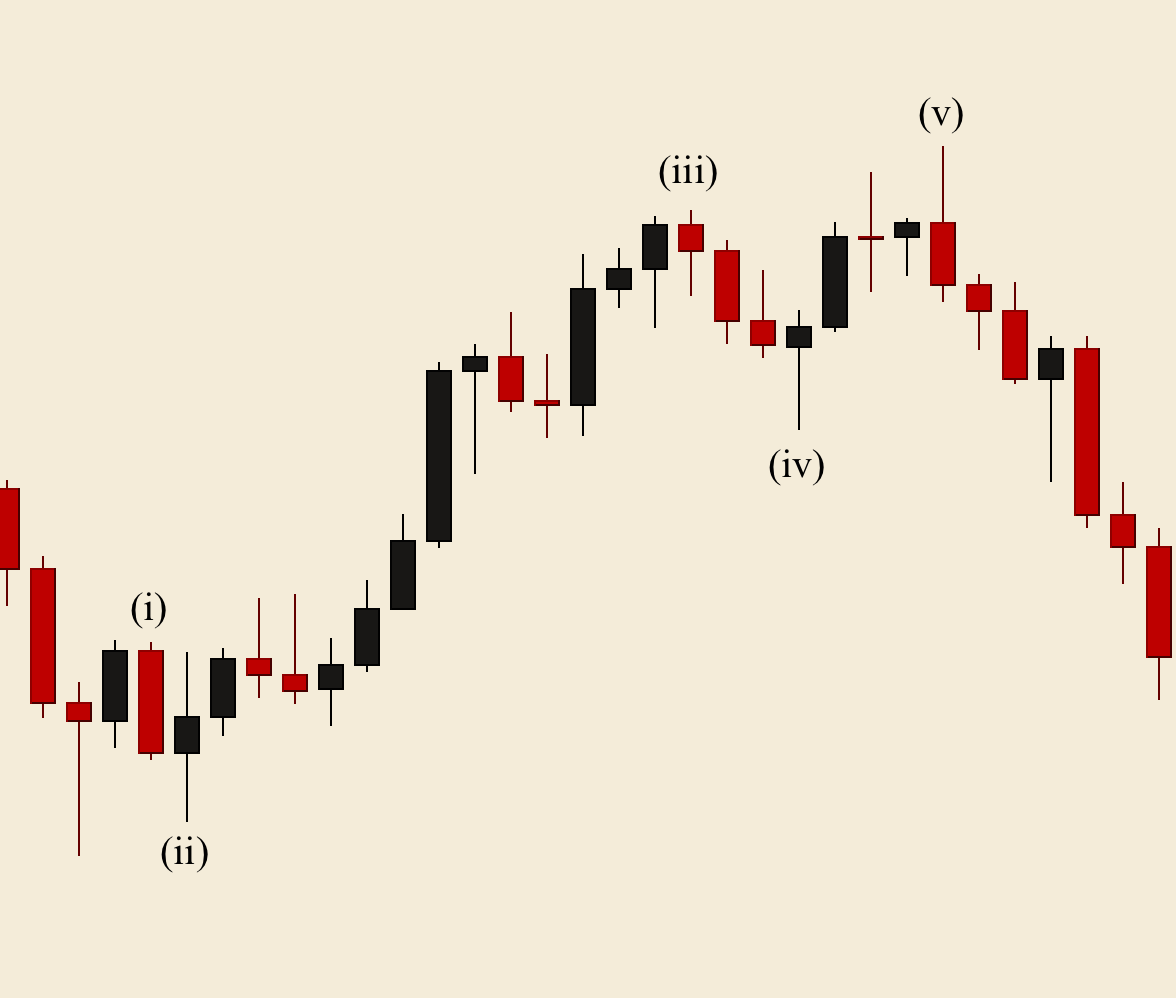
Rules
An impulse consists of five internal waves. Waves 1 and 5 must always be either impulses or diagonals, while wave 3 must always be an impulse on its own and can never be a diagonal. Within the sequence, wave 3 must never be the shortest wave when measured in terms of percentage gain or loss.
Wave 2 is always a corrective pattern and must not retrace more than 100 percent of wave 1. It may take the form of any corrective structure except a triangle. However, it may appear as a complex corrective combination, such as WXY or WXYZ, provided that the structure ends with a triangle.
Wave 4 must not enter the price territory of wave 1 and must always form as a corrective pattern of any type.
Guidelines
Waves 2 and 4 tend to display alternation relative to each other, as outlined in the introduction of this guide. Wave 2 typically retraces more deeply into wave 1 than wave 4 does relative to wave 3. Wave 2 most commonly develops as a simple corrective pattern, such as a zigzag or a double or triple zigzag, whereas wave 4 more often develops as a complex corrective pattern, including triangles, flats, or double and triple threes.
In almost all impulse waves, one of the action waves—wave 1, wave 3, or wave 5—becomes extended, with wave 3 being the most common candidate. Extended waves can themselves contain multiple further extensions.
Wave 5 may fail to move beyond the end of wave 3, a condition known as truncation. This is relatively uncommon and usually occurs when wave 3 has been exceptionally long and overstretched. Truncation often leads to significant price reversals. Wave 5 is unlikely to form a diagonal if wave 3 is not extended.
An impulse wave is not considered complete until all sub-degrees have finished, for example a structure such as 5 of 5 of 5. In all cases, the wave count takes precedence over channel lines and Fibonacci targets. Wave 3 almost always displays the highest volume. If volume during wave 5 is comparable to that of wave 3, an extended fifth wave should be expected.
Fibonacci Retracement and Extension Guidelines
If wave 1 is extended, the combined movement from wave 3 through the end of wave 5 is often equal to 61.8% to 78.6% of the length of wave 1. In such cases, waves 2 and 4 are very likely to be shallow, typically retracing only 23.6% to 38.2%. When wave 1 is extended, wave 2 often terminates near the level of sub-wave 4 of wave 1, meaning the internal fourth wave within wave 1.
If wave 2 retraces more than 78.6% of wave 1, the interpretation that it is truly a wave 2 becomes increasingly questionable and may instead suggest an A-B corrective structure.
When wave 3 is extended, waves 1 and 5 are often nearly equal in both magnitude and duration. If perfect equality is absent, a 61.8% relationship is the next most common outcome. In these cases, wave 4 frequently terminates near the level of sub-wave 4 of wave 3 and tends to be relatively shallow, retracing approximately 23.6% to 38.2% of wave 3.
If wave 3 is both extended and very steep, it will often overshoot the trend channel drawn using the extremities of waves 1, 2, and 4. Despite this overshoot, the channel remains highly effective for estimating the termination of wave 5, as illustrated in the accompanying image.
If wave 4 retraces more than 50% of wave 3, it is often an indication that the structure may not be a wave 4. Wave 5 is more likely to become extended when waves 1 and 3 are approximately equal in size. When wave 5 does extend, it frequently terminates near the 161.8% Fibonacci extension relative to the price movement from wave 1 through wave 3.
Following an extended wave 5, the subsequent correction is often sharp and swift and typically ends near the extreme of sub-wave 2 of the extension. This behavior does not apply when the market is completing a fifth wave simultaneously across multiple degrees.